A great read
 Review by Tricia Barker
Rahila’s Secrets, the sequel to The Jewish Bride, continues Zara and Rahila’s story with a compelling blend of history, family secrets, identity, and human resilience. Judit Neurink creates a story that draws the reader into a world shaped by complicated relationships and the lasting consequences of choices made in the past.
What I especially enjoyed was the emotional depth of the characters. Rahila’s journey feels personal and thought-provoking, while the unfolding secrets keep the story moving and encourage you to keep reading to discover how everything connects.
Neurink does an excellent job of bringing together personal drama and a broader historical and cultural backdrop. The story raises interesting questions about belonging, loyalty, family, and the ways hidden truths can shape people’s lives.
A fascinating sequel that will appeal to readers who enjoy historical fiction, family mysteries, and character-driven stories. If you enjoyed The Jewish Bride, Rahila’s Secrets is a worthwhile continuation of Zara and Rahila’s journey.
Tricia Walker is a writer.
Learning about the often-kept secrets of history
 Review by Sherry Vernick Ostroff
Rahila’s Secrets, by Judit Neurink, is the sequel to The Jewish Bride, however one does not need to read the first book to understand the story of the protagonist, Zara Mahmoud. Zara, who lives in the Kurdish area of Iraq, had always thought she was Muslim, but when uncovering family secrets, she finds out she is really Jewish. This discovery is complicated by the fact of the coming danger that now faces her country and especially the Iraqi Jews: the expansion and takeover of Iraq by ISIS. Zara’s only escape, along with her mother, is to flee to Israel. It is her newfound Jewish lineage that saves her. On the surface, the story that Neurink presents is one I was familiar with from the twenty-teens news cycle: the fall of Iraq, the ISIS invasion, and the atrocities. But through Zara’s character, I learned so much more history: the plight of the Iraqi Jews; the kidnapping of young Jewish girls and their forced marriages to Muslim men; and the Yemenite Children Affair - after the creation of the State of Israel. This last one, I knew the least about. I found Rahila’s Secrets engaging, although wading through Zara’s ever-growing family tree was a bit of a challenge. However, the many names and connections did not deter my reading. There is a family tree at the end of the book, but I didn’t discover it until I finished reading. Lastly, as a treat, Neurink provides a lengthy author’s note which did not disappoint. I highly recommend this book for anyone who is interested in learning about often-kept secrets of history. In this I commend Neurink. We all need to know the full story.
Sherry Vernick Ostroff is a writer of six books, among them Remember Me Not.
A fast-paced novel
Review by Sherri Moshman-Paganos on Goodreads
In this fast-paced novel, Judit Neurink takes us into a world of forging a new life in a different land and discovering your roots. Our protagonist is Zara, a young woman who leaves the world she is familiar with in Kurdistan and ventures to Israel with her mother, Maryam, where they go to live out their Jewish roots. Zara is not saintly, she’s real and believable, makes mistakes, even lies, but we’re on her side. Leaving Kurdistan and the Muslim world she grew up in is a promise to Rahila, her deceased grandmother Rahila might have passed into the other world, but she left a diary that passed on to Zara. She also left a messenger, a black cat, Treen, who figures highly in the story, with a kind of magical power to help Zara.
As with most of Neurink’s novels, she draws on her experience and background as a journalist in Iraq. The intrigue and history of the Middle East comes alive in her fictional characters. In Rahila’s Secrets, we have Isis or Daesh invading Mosul (Iraq) in 2014. What most readers don’t know about is the mass exodus of the Jewish population in Baghdad in the 1950’s and 60’s. Muslims who actually have Jewish roots like in Kurdistan like some of Zara’s family, were either unaware or too afraid to express this.
Besides the theme of the importance of knowing your roots — DNA tests figure in the book — there’s also the theme of uprooting yourself.. As seems realistic, Zara is torn about her feelings of now living in Israel. But there she meets Bram, a proud Israeli (also originally an immigrant) and falls in love. There’s a lot of believable conflict between the two about politics — Israel is not presented as a panacea for them, in fact there are scenes of violence and Zara questions the Israeli narrative that Bram holds dear. But there’s another source of conflict and that’s Zara’s former boyfriend who still has a role in her life.
The story gets more and more exciting at the end with its surprises and external events, yet we never abandon Zara’s own inner conflicts about her present life and relationship with Bram.
A very enjoyable novel with a well drawn fictional world that Neurink creates using a backdrop of history that I was very drawn to learning about.
Sherri Moshman-Paganos is a former teacher and journalist
The same and yet different
Review by Lori Escalera
Rahila's Secrets is a wonderful novel based on historical occurrences, delving into themes of personal and historical trauma, identity, and relationships. The story is set against the complex backdrops of the Middle East as Kurdistan eliminated its Jewish populations and Israel achieved statehood. Through its narrative, Judit Neurink explores how individual and collective histories shape the characters' lives, focusing on their struggles with the impact of past traumas on their present-day relationships. Judit skillfully examines the lingering effects of past events on personal identity that are forced onto the story’s characters as they are faced with elements out of their control.
The settings of Israel, Kurdistan, and Turkey provide a rich backdrop, allowing the novel to explore the impact of cultural and historical forces on individual lives, revealing how we are so very much the same and yet also so very different. The author is very knowledgeable of the complexities of these regions and does a superb job illustrating how history and place influence the characters' journeys. These themes are interwoven throughout the novel, creating a layered exploration of how history, identity, and relationships intersect.
The book builds to an extraordinary world of intrigue, richness, and suspense, holding my attention spellbound until the very last pages! Kudos to Judit Neurink for bringing us another exceptionally beautiful and rich story about the difficulties of traversing over time and space to build our lives and personal identities, embracing the bad, the good, and everything in between, which make up tremendous life stories.
Lori Escalera is a cross medium artist
Dilemma´s
 Review by Marjon Nooij
DNA Doesn’t Lie is not a scientific book. It is a well-researched and reflective, yet personal piece of journalism exploring ethical and moral dilemmas, in which Neurink complements her own journey with the experiences of others, making it both intimate and socially relevant. It touches on major themes, such as identity, family, memory and the Holocaust, and raises questions about the impact of DNA testing. What do you want to know, and what might you perhaps prefer not to know?
Marjon Nooij reviews books on Tzum
Warned
Review by Sherri Moshman-Paganos
If you’ve ever thought of doing DNA testing, then Judit Neurink’s book DNA Does Not Lie, People Do is the definitive book for you. She combines impeccable research, including lively and informative interviews with experts, with her own interest in sampling a number of DNA tests herself. The result is a fascinating look at the current popularity of DNA testing. In the book, the author particularly looks at Jewish interest in testing. We are warned that DNA tests are not something to go into lightly! Although it’s usually important for us to find out about our past, Neurink warns us that results in some cases can be devastating as well. This is the perfect book for us to be informed about both the positive and negative aspects of DNA tests.
Sherri Moshman-Paganos is a former teacher and journalist
Follow her quest
Review by Kathryn Lukey-Coutsocostas
Neurink aches to uncover her link to possible Jewish ancestry. Does she have one? Does she not? Follow her quest – including the exploration of the intricacies of DNA testing – whether you are considering doing your own genealogical research or not. The journey may turn your own world upside down.
Kathryn Lukey-Coutsocostas is a writer, journalist and columnist
Hooked
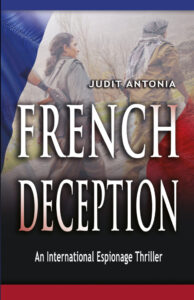
French Deception
Review Martha Rincon
Loved it! The story kept me hooked from the beginning. It's the perfect combination of suspense, romance and a great history background that I could understand even not being well-versed in Iran Iraq war politics. Looking forward to reading more from this author.
Martha Rincon is an influencer on Instagram and YouTube, as Simplemente diosas
Well paced thriller
French Deception
Review Sherri Moshman-Paganos
French Deception is a well paced thriller. When photographer/protagonist Susan sees a puzzling picture on TV of her beloved Nicholas in a position of French minister, she starts her reminisces of her past relationship with him. We are at her side, feeling her intense love and longing as she tries to solve the mystery of who he really is and unearth the deep intrigue and espionage that he has been involved in. (on Goodreads)
Sherri Moshman-Paganos is former teacher and journalist
Page-turner
French Deception
Review Caroline Swettenham
This is a thriller that keeps you guessing right up to the last page. A real page-turner that takes you to Iraq and France to meet intriguing characters. You will not be disappointed by Judit's latest work, which draws on her extensive knowledge and experience as a journalist in Iraq.
Caroline Swettenham is an editor and translator in Athens
Your husband is a murderer
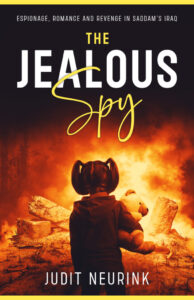
The Jealous Spy
Review Diane Shugart
Judit Neurink draws on her long experience reporting on Iraq and the Kurds to craft another layered story where the conflicts in the headlines play out in the emotional battles fought by her characters. Love can skew our judgement and so can politics.
Anna must navigate these two passions as she untangles the truths in Iraq and in her relationships to investigate, on the field but also in her heart, a shocking message: “Your husband is a murderer.”
Diane Shugart, writer and translator
It feels like I was there
The Jealous Spy
Review by Rina Spigt
Some news items on TV I will never forget. Breaking news, real and raw: world history. Like on a Sunday in December 2003: ‘Ladies and gentlemen, we got him!’ A report of how Saddam Hussein was found in a cellar somewhere in Iraq’s countryside. We see a hole in the ground and a clochard: the long sought after and run down dictator.
I thought: ‘it’s like a movie or novel’. But I realized that the combination of journalism and fiction is not always a happy one.
Yet it is very well possible to write a suspenseful novel and situate it in an existing world. Judit Neurink’s latest novel is situated mainly in the Kurdish part of Iraq during Saddam Hussein’s cruel rule. She knows the decors and images there, as a journalist in the Middle East she saw them up close.
The story in short: Dutch journalist Anna is married to photographer Karim who is from Iraqi descent and was politically active in Iraq. While she is married to him and on a work trip in Iran, she falls in love with her colleague Davoud. Anna gets pregnant with Davoud’s daughter Zina, who Karim presumes is his child.
A large part of the story covers Anna’s and Davoud’s search to find Zina, whom Karim has kidnapped and taken to the Middle East. We are confronted with political intrigue in an atmosphere of threats and danger. But nowhere, the story loses its believability, this does not seem to be made up, it is real.
The scene I enjoyed most reminds me of the TV images I described: the farm and the hole under the ground where Saddam was found. Here, Neurink brings the three main characters in the book together. Here, the last conversation takes place, reluctant at first and full of questions, but then harder and more confronting. It’s about revenge and destruction, but also about ‘how to go on from here?’ And that’s exactly what I would like to know myself too.
It’s fiction, but it feels as if I was there.
Rina Spigt, journalist
First review of The Jealous Spy
The Jealous Spy
Review by Kathryn Lukey-Coutsocostas
When we fall in love, do we really know who the other person is?
Judit Neurink presents a love story set amidst radical Islamic surroundings: hush-hush meetings with activists, teas in muted households, and deadly betrayal and intrigue. While it is fiction, Neurink weaves in personal insights from her many years of living and working in the Middle East.
Thankfully, in this tale, female tenacity triumphs.
Kathryn Lukey-Coutsocostas, writer (columnist/journalist/features writer)
‘The Good Terrorist’ is almost too real
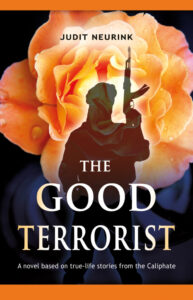
The Good Terrorist
Review by Chris Stirling
Judit Neurink’s book takes you places you really hope you never have to experience. Her vivid depiction of life inside the Caliphate is almost too real. A hateful world in which goodness is crushed by fear.
For those of us who barely skim the news which is reported, this opens our eyes wide to the horrors of many things never properly covered in our sanitised media. You can’t help but share in the protagonist’s miscomprehension of what human beings are prepared to do to each other in the name of religion. The book’s characters are well written, utterly believable, and brought to life not just by the events that befall them, but also by the emotions with which they respond to those events.
It’s immediately clear that Neurink has spent a lot of time in the region, growing to understand the particular idiosyncrasies of this awful chapter in the history of our planet. The book encourages us to think not only about how we respond to religion and the notion of terrorism, but more than this, it makes us consider the very nature of our humanity. You are left with a feeling of helplessness, of despair for how so many people can be so brutally marginalised, so close to home, without it registering on the average person’s daily news radar.
What happened in the Caliphate during the dark years portrayed in The Good Terrorist needs to be well chronicled, to bring home horrible truths and open our eyes to the atrocities we as humans can inflict on each other. In Judit Neurink, a skilful chronicler has been found, and the pages of her book are in every way as fascinating as they are traumatic. She knows that to simply tell the story of the horrors of ISIS would alienate readers, particularly those who don’t often find their fiction so framed by fact. So for every cruel machination of ISIS that is described, for every act of terror or wanton destruction, there is also a counterfoil.
We are shown how humanity in its purest form can flourish abundantly, if not always visibly, in the harshest of environments. We are told as much a story of love, hope and redemption as we are one of death, destruction and hopelessness. This is what makes this novel so good. The reader is constantly oscillating between the abject hopelessness of a situation, and the unbelievable bravery and courage of the love that counters it. The fundamental believability of what is in essence a work of fiction, comes quite clearly from the exposure the author has had to the situations described, but also from diligent and detailed research, and a brilliant understanding of human psyche. I look forward to reading much, much more from Judit Neurink in the coming years
Chris Stirling, Edinburgh
I simply could not put down ‘The Good Terrorist’!
The Good Terrorist
Review by Boris O. Dittrich
Neurink’s novel is based on true-life stories from the Caliphate. And this is immediately clear by the way she draws you into the story of the Dutch woman Rose whose ex-partner from Moroccan descent Ahmed secretly left for the caliphate in Syria. Why did he leave? Did he become religious and supportive of ISIS?
The novel starts when Rose happens to see a picture of Ahmed on the internet. ISIS claims he died while carrying out a suicide attack near the Turkish border. Rose finds this hard to believe and starts investigating what has happened.
Neurinks description of the cruelties and inhuman behavior in the Caliphate and what the characters in her story must endure, showcases her knowledge about ISIS and this region of the world. You can feel, hear, see and smell the way people lived under inhuman conditions, while corruption, betrayal, cruelty and the hypocrisy of radical Islam were wide spread. The novel borders on the thriller genre as well. As reader you simply want to read on to find out what happened to Ahmed. Without spoiling the plot I can disclose that Rose goes to the region to investigate what happened to her ex-husband. We see the conditions in which people live in refugee camps through her eyes. This makes the story easily accessible for people in the rest of the world.
Neurink has a great talent of depicting her characters. They come to life as real people, each traumatised by the way they were confronted with radical Islam. Fortunately, the story is not only about painful, negative events. It also contains uplifting elements of brave women and men who reject and resist radical Islam and who find their way out of the hellish conditions that were imposed on them.
Apart from thoroughly enjoying this suspenseful novel I learned more about the plight of Yazidi women who were captured by ISIS to become sex slaves. They could escape thanks to people with a moral compass who operated in secret networks.
I simply could not put down ‘The Good Terrorist’ and loved travelling under Neurink’s guidance to the Caliphate. And am happy to be back!
Boris O. Dittrich, Novelist and Senator in the Netherlands
Rich in detail
The Good Terrorist
Review by Quentin Sommerville
“The tension in Judit Neurink’s latest novel is like a weight upon your chest, rich in detail it captures the fear and uncertainty as Islamic State’s emerged, and the group’s ability to reach far beyond its borders into the lives and minds of recruits in the west.”
Quentin Sommerville, war reporter for the BBC
Expert inside glance
The Good Terrorist
Review by Willem Meiners
Judit Neurink has written a quality fictional account of a painfully nonfictional reality. She provides an expert inside glance into a world that most of us know nothing about: the horror and anguish of families who are left to wonder whether and why loved ones have joined a terrorist organization. The author has lived and worked among Iraqi and Kurd fighters for years, and bears witness of what she knows firsthand and has seen upfront like few others can.
Willem Meiners, ex publisher and editor, author of A President in Love, a biography of Warren Harding